LURAY MARKER
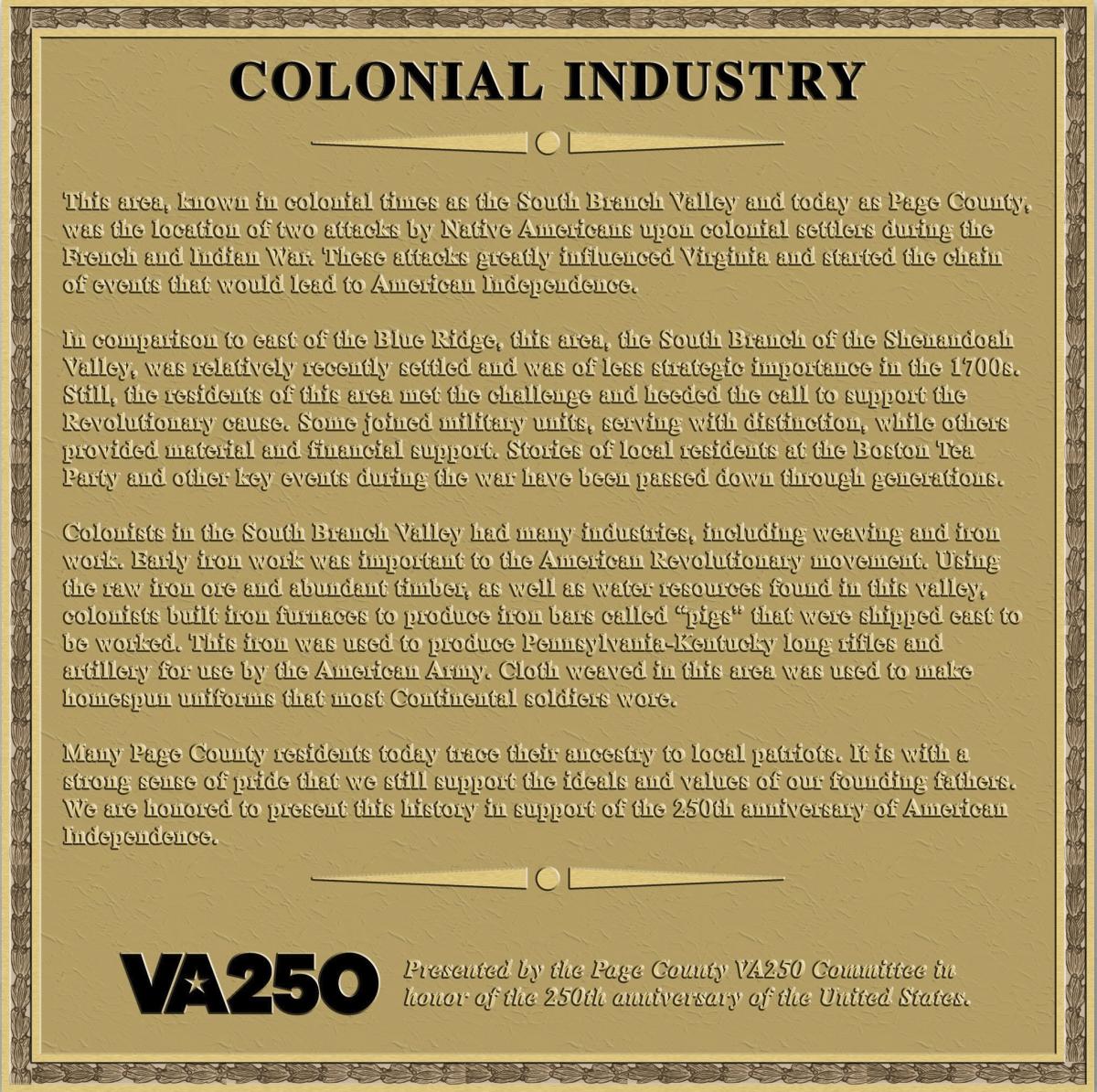
This area, known in colonial times as the South Branch Valley and today as Page County, was the location of two attacks by Native Americans upon colonial settlers during the French and Indian War. These attacks greatly influenced Virginia and started the chain of events that would lead to American Independence.
In comparison to east of the Blue Ridge, this area, the South Branch of the Shenandoah Valley, was relatively recently settled and was of less strategic importance in the 1700s. Still, the residents of this area met the challenge and heeded the call to support the Revolutionary cause. Some joined military units, serving with distinction, while others provided material and financial support. Stories of local residents at the Boston Tea Party and other key events during the war have been passed down through generations.
Colonists in the South Branch Valley had many industries, including weaving and iron work. Early iron work was important to the American Revolutionary movement. Using the raw iron ore and abundant timber, as well as water resources found in this valley, colonists built iron furnaces to produce iron bars called “pigs” that were shipped east to be worked. This iron was used to produce Pennsylvania-Kentucky long rifles and artillery for use by the American Army. Cloth weaved in this area was used to make homespun uniforms that most Continental soldiers wore.
Many Page County residents today trace their ancestry to local patriots. It is with a strong sense of pride that we still support the ideals and values of our founding fathers. We are honored to present this history in support of the 250th anniversary of American Independence.
STANLEY MARKER
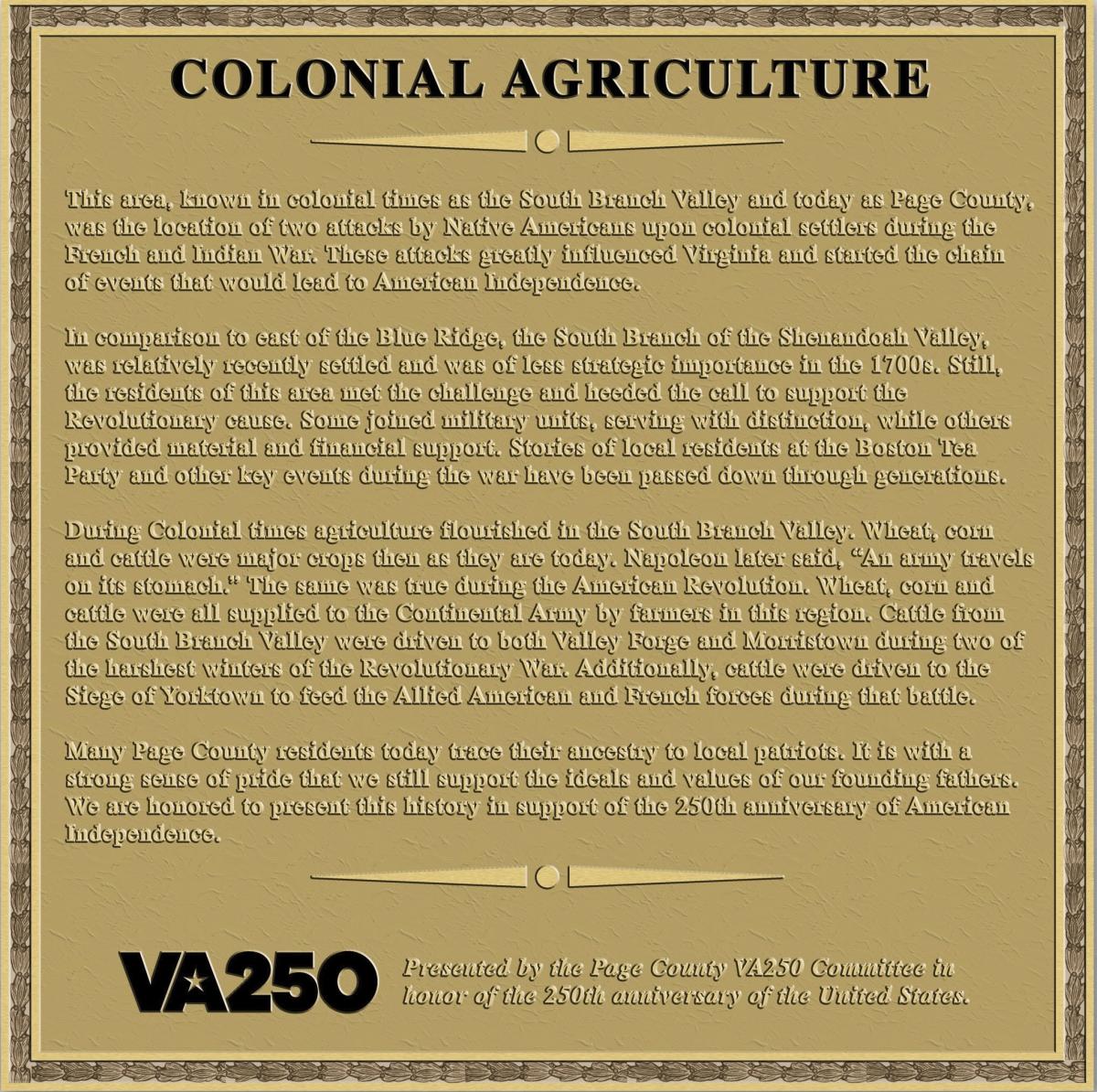
This area, known in colonial times as the South Branch Valley and today as Page County, was the location of two attacks by Native Americans upon colonial settlers during the French and Indian War. These attacks greatly influenced Virginia and started the chain of events that would lead to American Independence.
In comparison to east of the Blue Ridge, the South Branch of the Shenandoah Valley, was relatively recently settled and was of less strategic importance in the 1700s. Still, the residents of this area met the challenge and heeded the call to support the Revolutionary cause. Some joined military units, serving with distinction, while others provided material and financial support. Stories of local residents at the Boston Tea Party and other key events during the war have been passed down through generations.
During Colonial times agriculture flourished in the South Branch Valley. Wheat, corn and cattle were major crops then as they are today. Napoleon later said, “An army travels on its stomach.” The same was true during the American Revolution. Wheat, corn and cattle were all supplied to the Continental Army by farmers in this region. Cattle from the South Branch Valley were driven to both Valley Forge and Morristown during two of the harshest winters of the Revolutionary War. Additionally, cattle were driven to the Siege of Yorktown to feed the Allied American and French forces during that battle.
Many Page County residents today trace their ancestry to local patriots. It is with a strong sense of pride that we still support the ideals and values of our founding fathers. We are honored to present this history in support of the 250th anniversary of American Independence.
SHENANDOAH MARKER

This area, known in colonial times as the South Branch Valley and today as Page County, was the location of two attacks by Native Americans upon colonial settlers during the French and Indian War. These attacks greatly influenced Virginia and started the chain of events that would lead to American Independence.
In comparison to east of the Blue Ridge, this area, the South Branch of the Shenandoah Valley, was relatively recently settled and was of less strategic importance in the 1700s. Still, the residents of this area met the challenge and heeded the call to support the Revolutionary cause. Some joined military units, serving with distinction, while others provided material and financial support. Stories of local residents at the Boston Tea Party and other key events during the war have been passed down through generations.
Many of the early settlers of the South Branch Valley came here for religious freedom. This area had Mennonites, Dunkards, Brethren, Baptists, Lutherans, Anglicans and Methodists. This microcosm of religion in the colonies shows why religious freedom was a cornerstone of the Revolutionary movement. It also shows the difficulties of the Revolution, as several of these religious sects were pacifists and refused to participate in the fighting.
Many Page County residents today trace their ancestry to local patriots. It is with a strong sense of pride that we still support the ideals and values of our founding fathers. We are honored to present this history in support of the 250th anniversary of American Independence.
COUNTY MARKER
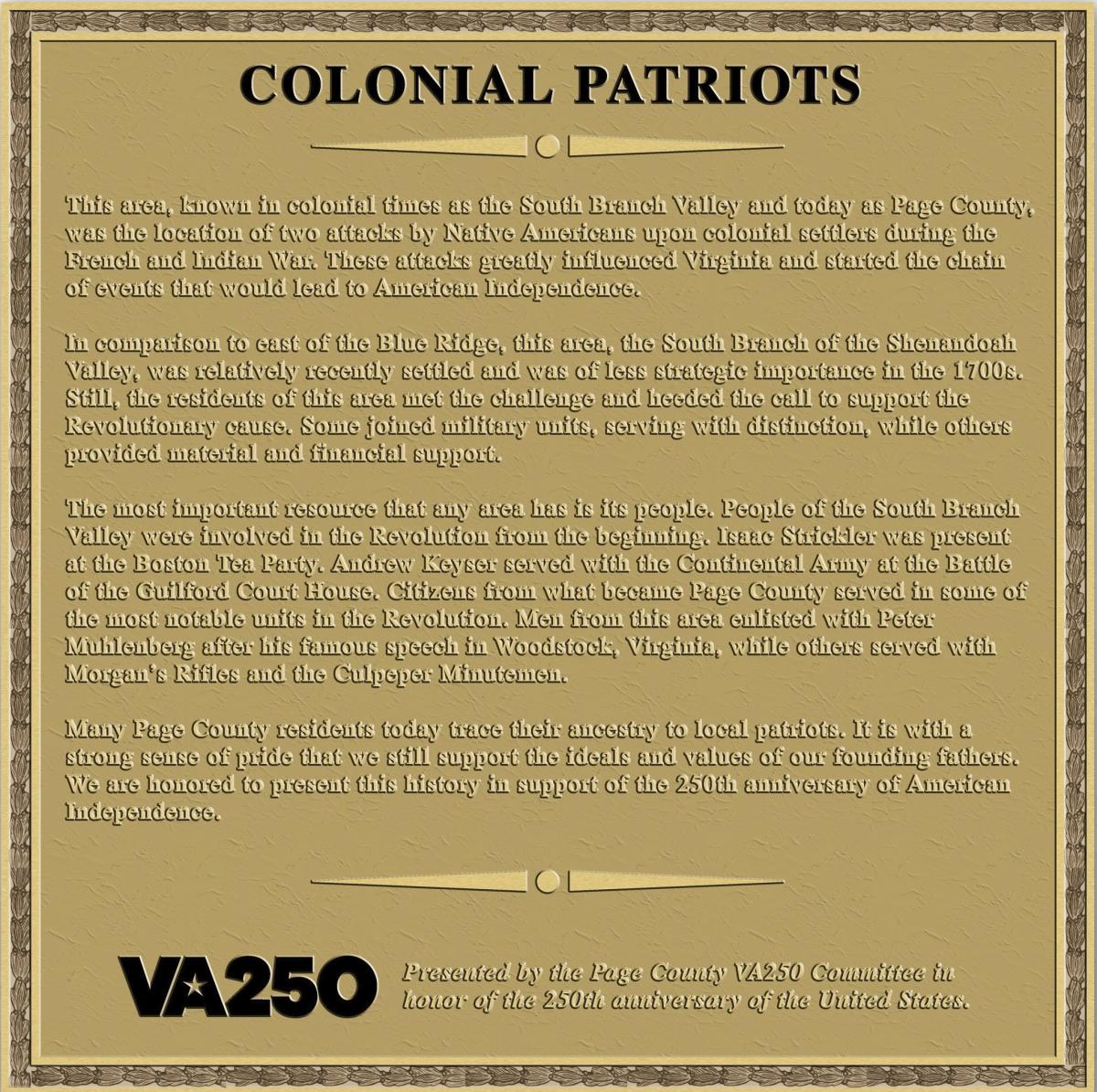
This area, known in colonial times as the South Branch Valley and today as Page County, was the location of two attacks by Native Americans upon colonial settlers during the French and Indian War. These attacks greatly influenced Virginia and started the chain of events that would lead to American Independence.
In comparison to east of the Blue Ridge, this area, the South Branch of the Shenandoah Valley, was relatively recently settled and was of less strategic importance in the 1700s. Still, the residents of this area met the challenge and heeded the call to support the Revolutionary cause. Some joined military units, serving with distinction, while others provided material and financial support.
The most important resource that any area has is its people. People of the South Branch Valley were involved in the Revolution from the beginning. Isaac Strickler was present at the Boston Tea Party. Andrew Keyser served with the Continental Army at the Battle of the Guilford Court House. Citizens from what became Page County served in some of the most notable units in the Revolution. Men from this area enlisted with Peter Muhlenberg after his famous speech in Woodstock, Virginia, while others served with Morgan’s Rifles and the Culpeper Minutemen.
Many Page County residents today trace their ancestry to local patriots. It is with a strong sense of pride that we still support the ideals and values of our founding fathers. We are honored to present this history in support of the 250th anniversary of American Independence.